
Starting an LLC in Texas: Your Complete Beginner’s Guide
Content Updated
Updated:01:08:2025
Posted:01:08:2025

There’s a reason Texas is home to some of the biggest names in business. Dell, AT&T, American Airlines, and now even SpaceX, all operate from the Lone Star State. But you don’t need a billion-dollar budget to launch something in Texas. Whether you’re turning your weekend web design gigs into a full-time thing or finally opening that coffee cart you’ve been dreaming about, starting a Texas LLC is a smart move.
An LLC, short for limited liability company, helps protect your personal assets, simplifies your taxes, and gives your business a solid legal foundation. Sound complicated? Don’t worry. This step-by-step guide will walk you through exactly how to start an LLC in Texas. From figuring out a name to filing paperwork, we’ll break down the wall of legal jargon and show you exactly what to do (no law degree or AI required).
Why Start an LLC in Texas?
Texas doesn’t just promise big things. It delivers real protection and flexibility, whether you’re starting a brand-new venture or upgrading from a sole proprietorship. Texas is known for its entrepreneur-friendly setup, making it a popular choice for both small businesses and large corporations.
Here are some of the advantages of a Texas LLC at a glance:
- No personal income tax. Keep more of your profits.
- Affordable startup costs. Just a flat $300 filing fee, with no annual state renewal costs.
- Simple compliance. Fewer regulations mean you can focus more on growing your business rather than drowning in paperwork.
- Limited liability protection. Your personal finances are protected from business risks.
- No hidden requirements. Texas is upfront about fees and filings.
- High franchise tax threshold. Businesses won’t owe franchise tax if revenue is under $2.47 million.
Now that you’ve got the “why”, let’s get into the “how”.
An LLC, short for limited liability company, helps protect your personal assets, simplifies your taxes, and gives your business a solid legal foundation. Sound complicated? Don’t worry. This step-by-step guide will walk you through exactly how to start an LLC in Texas. From figuring out a name to filing paperwork, we’ll break down the wall of legal jargon and show you exactly what to do (no law degree or AI required).
Why Start an LLC in Texas?
Ready to make it official? Here’s how to get an LLC in Texas in six clear steps.
Step 1: Choose Your LLC Structure
Before you dive into the paperwork, it’s important to decide how you want your LLC to be structured and managed. These decisions affect how your business operates, how profits are divided, and how liability is shared.
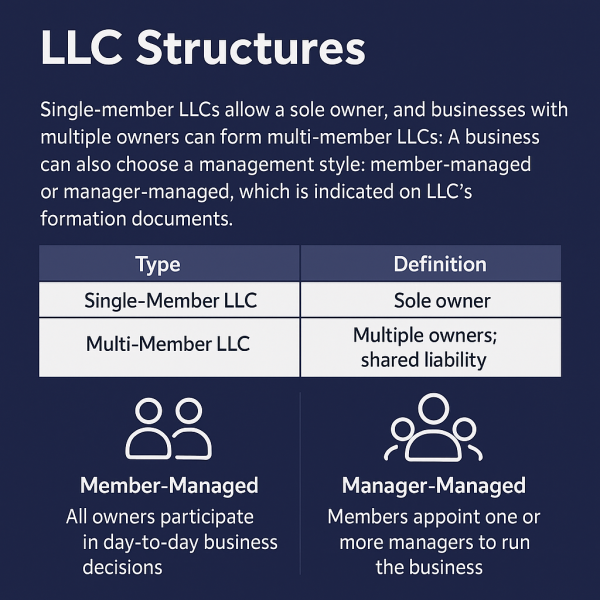
Tip: Most small businesses default to member-managed for simplicity. But if you want a more hands-off role, manager-managed might be the better fit.
With these important decisions made, you’re ready to move forward with naming your LLC.
Step 2: Name Your Texas LLC
Aside from picking a name that stands out and reflects what you do, your LLC name also needs to meet state naming regulations. Here are the main requirements to keep in mind:
- Must include an indicator like “limited company”, “limited liability company”, “LLC”, or “Ltd. Company”.
- Must be clearly different from existing business names on record (No “Netflicks” if “Netflix” is taken).
- Must not be misleading or imply government affiliation.
- Must not contain offensive words.
- Specific terms like “engineer”, “credit union”, or “university” may require extra licensing paperwork, even if you’re actually offering those services.
A quick way to check if your LLC name is available is through the Taxable Entity Search tool. Just keep in mind, it’s not always 100% up to date. For a more reliable check before you officially apply for an LLC in Texas, contact the Secretary of State for a preliminary name availability determination.
- Call (512) 463-5555
- Use relay service: 711
- Email: [email protected]
- Visit the SOSDirect portal ($1 per search)
Tip: Check domain (web address) availability and the USPTO database (trademark search) to avoid issues later on.
Not ready to file yet? You can reserve a name for 120 days for a $40 fee with options to extend. Reserve online using the SOSDirect portal or by mail using Form 501. Also, keep in mind that you don’t have to operate under your LLC’s legal name. Let’s say your name is too long or you’re expanding services down the line, you can file a Doing Business As (DBA), also called an Assumed Name Certificate, with the county clerk and Secretary of State for a $25 filing fee.
With a name that checks all the boxes, you’re ready for the next step: appointing someone to legally accept documents on your behalf.
Step 3: Appoint a Texas Registered Agent
A registered agent is a person or business authorized to receive documents for your LLC. Texas legally requires you to have one to ensure there’s a reliable point of contact to handle legal documents promptly and appropriately.
In Texas, a registered agent must meet the following criteria:
- Be at least 18 years old
- Have a physical Texas address (no P.O. boxes)
- Be available during regular business hours at the given address
You can appoint yourself or an employee of your LLC, but keep in mind that the agent’s name and address will be listed publicly. To avoid the hassle of always needing to be available and to protect personal privacy, many business owners choose to hire a registered agent service. You’ll include your registered agent’s information as part of your Texas LLC application in the next step.
Step 4: File the Certificate of Formation Texas (Form 205)
The Texas Certificate of Formation, also known as Form 205 (or Articles of Organization in some other states), is the official application that legally establishes your LLC in Texas. It may sound intimidating, but the form is relatively straightforward and only asks for basic information about your LLC, most of which you’ve already figured out in the first two steps.
Here’s some of the key information you’ll need to provide:
- Your LLC name
- Registered agent name and address
- Governing authority (whether your LLC is member-managed or manager-managed)
- LLC’s purpose (this can be general)
- Name and address of the organizer
- Effective date (either immediate or set for a future date)
To submit your Texas LLC registration, you can file the Certificate of Formation with the Secretary of State online through the SOSDirect portal, in person, by fax, or by mail, along with a flat filing fee of $300. Processing times vary, but it generally takes about 10 to 15 days if filed online. Once approved, you’ll receive a stamped Certificate of Formation confirming that your LLC is officially registered!
Step 5: Create an Operating Agreement
An operating agreement is exactly what it sounds like. It’s a legal document that outlines how your LLC will be run. It covers things like profit-sharing, voting rights, ownership percentages, member roles, and procedures for adding or removing members. This step isn’t required by the state of Texas, but it’s a smart step that can protect you down the road.
💡See words you’re not familiar with? Refer to our Glossary for easy-to-understand explanations.
It shows banks and investors that your business is serious and provides clear guidelines if disputes come up between members of your LLC. More importantly, it helps maintain your limited liability protection by proving your LLC is a separate entity.
You can create an operating agreement with the help of a lawyer or by customizing one of the many quality templates available online. You won’t need to file this with the state, but make sure to keep a signed copy with your other important business records. With your operating agreement set up, you’re ready for the final step before you can start operating.
Step 6: Get an EIN (Federal Tax ID) from the IRS
An EIN, or Employer Identification Number, is a unique nine-digit number issued by the IRS to identify your business for tax purposes. Think of it as a Social Security Number for your LLC. You’ll need it to open a business bank account, hire employees, and file federal taxes. It’s a way to separate your personal and business finances, adding another layer of limited liability protection.
Apply for an EIN for free through the IRS website, by fax, or by mail. If you apply online during business hours, you can even receive your EIN instantly. And with that, you’re officially in business! To make sure your LLC remains fully compliant, let’s walk through a few final steps you should complete after registering.
An LLC, short for limited liability company, helps protect your personal assets, simplifies your taxes, and gives your business a solid legal foundation. Sound complicated? Don’t worry. This step-by-step guide will walk you through exactly how to start an LLC in Texas. From figuring out a name to filing paperwork, we’ll break down the wall of legal jargon and show you exactly what to do (no law degree or AI required).
What to Do After Completing Your Texas LLC Registration
Taking care of the following steps will help you avoid fines, protect your assets, and set your business up for success.
Get the Right Business Licenses and Permits
There’s no general business license requirement to operate an LLC in Texas, but certain industries may require specific business licenses and permits. For example, if your business sells food or handles specialized equipment, you need additional clearances. To make sure you have all the necessary approvals, be sure to check with the Texas Department of Licensing and Regulation as well as your local city or county offices for the appropriate applications and procedures.
Understand Tax Obligations in Texas
Taxes are one area many businesses choose to hand off to the experts. But, if you have the time to learn the basics, they’re completely doable on your own.
In Texas, your LLC’s profits pass directly to you and other members. This is called pass-through taxation, meaning the business itself doesn’t pay federal income taxes. Instead, you’ll report the income on your personal tax return and pay federal income and self-employment taxes. How you file depends on your business structure and revenue.
The good news is that Texas has no state income tax. The main state tax to watch for is the franchise tax, but it only applies if your LLC’s annual revenue exceeds $2.47 million. Depending on the type of business you have, you may also need to handle additional taxes such as sales and use tax, employer taxes, or industry-specific fees.
Note: If you have employees from out-of-state or in multiple states,
We break down these taxes in more detail in our guide Texas Business Tax Requirements.
Maintain Compliance
While these state-level requirements are essential, don’t forget that your county or city most likely has additional rules.
Some cities and counties in Texas have their own requirements, especially the bigger ones. Here’s a quick overview of what you can expect in some of Texas’s largest counties.
County | Common Local Requirements | Where to Check |
Harris County | Assumed Name (DBA) filing with the County Clerk Local permits depending on the type of business | |
Tarrant County | DBA registration City regulations for specific business operations | |
Dallas County | DBA filing if operating under a different name Specific zoning and signage regulations | |
Travis County | Home-based business permits City-level business licensing and zoning | |
Bexar County | DBA registration with Bexar County Clerk City permits required for health or food service businesses |
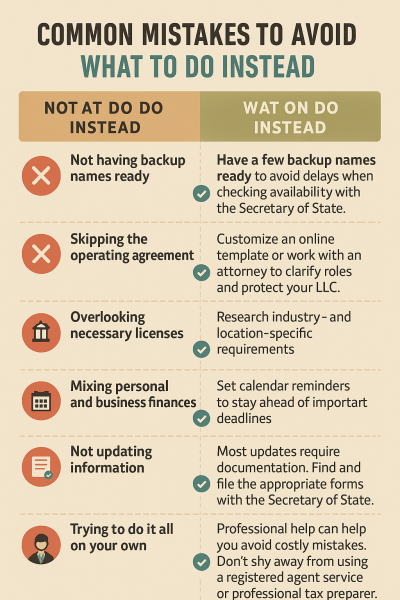
Keeping up with licenses, taxes, and local rules can feel like a lot. But, missing even one piece can lead to unwanted fees and troubles down the road. Before you move forward, let’s cover a few common mistakes new Texas business owners often make, so you can avoid them.
Common Mistakes When Forming an LLC in Texas
How to Create an LLC in Texas: Checklist & Tools
You’re well on your way to running a fully compliant business in Texas. Use these tools and templates to stay organized and keep things moving:
- Texas LLC Formation Checklist
- Form 205- Certificate of Formation
- Operating Agreement Template
- Form 401- Change of Registered Agent/Office
- Form 503- Assumed Name Certificate
- Form 501- Name Reservation
- Form SS-4- EIN Application (IRS)
- Form 05-102- Public Information Report
For a full list of forms you may need, visit the Texas Secretary of State Forms page.
With everything we’ve covered, starting your Texas LLC will hopefully feel a little less overwhelming. Keep this guide on how to set up an LLC in Texas handy as you move through the process. One step at a time, you’re on your way to bringing your business dreams to life.
An LLC, short for limited liability company, helps protect your personal assets, simplifies your taxes, and gives your business a solid legal foundation. Sound complicated? Don’t worry. This step-by-step guide will walk you through exactly how to start an LLC in Texas. From figuring out a name to filing paperwork, we’ll break down the wall of legal jargon and show you exactly what to do (no law degree or AI required).
There’s a reason Texas is home to some of the biggest names in business. Dell, AT&T, American Airlines, and now even SpaceX, all operate from the Lone Star State. But you don’t need a billion-dollar budget to launch something in Texas. Whether you’re turning your weekend web design gigs into a full-time thing or finally opening that coffee cart you’ve been dreaming about, starting a Texas LLC is a smart move.
An LLC, short for limited liability company, helps protect your personal assets, simplifies your taxes, and gives your business a solid legal foundation. Sound complicated? Don’t worry. This step-by-step guide will walk you through exactly how to start an LLC in Texas. From figuring out a name to filing paperwork, we’ll break down the wall of legal jargon and show you exactly what to do (no law degree or AI required).